> For the complete documentation index, see [llms.txt](https://docs.eventication.com/event/llms.txt). Markdown versions of documentation pages are available by appending `.md` to page URLs; this page is available as [Markdown](https://docs.eventication.com/event/general/documents.md).

# Documents

Need somebody to sign a document?

Many events need people to sign a contract before they start working.

Documents is a great place to do this fully digitally.

### Create a new document

When creating a new document you have to give it a name and pick a category.

{% hint style="info" %}
A category contains the possible receivers of the document, like

* members
* groups
* visitors of a list form
* ...
  {% endhint %}

### Description

The description is something that is shown where the document name shows up on the platform.

### Body

The body of the document is the actual text that is going to be aggreed to by signing it. This is translatable in the supported languages of the platform.

#### Variables

The body of the document allows you to add variables to the text. These variables will be replaced by actual values when the document is opened by the user.

<details>

<summary>Examples of variables</summary>

<table data-header-hidden><thead><tr><th width="226.33203125"></th><th></th></tr></thead><tbody><tr><td><code>{{name}}</code></td><td>The name of the user</td></tr><tr><td><code>{{today_with_day}}</code></td><td>The current date when the document is going to be signed</td></tr><tr><td><code>{{company}}</code></td><td>The company of the user</td></tr><tr><td><code>{{email}}</code></td><td>The email address of the user</td></tr><tr><td><code>{{all_available_days}}</code></td><td>All the days the user is available for the event</td></tr><tr><td><code>{{bank_account}}</code></td><td>The user's bank account number</td></tr></tbody></table>

</details>

You can find more variables under the body text area. Read more [here](/event/misc/variables.md).

A document also gives you a variable of its own, so you can hand people the link to sign it. Write to the people who still have to sign, add that document's variable to your text, and everybody receives their own signing link. This works for documents that associations sign as well: the leader of the association receives the link to sign it on behalf of their own association.

{% hint style="info" %}
The list of document variables is collapsed by default. Click it open to see every document and to copy the variable you need.
{% endhint %}

#### Formatting

Under the body text area there is another button where you can find formatting details. Formatting allows you to use titles, hyperlinks, bold & underscored text, etc. Read more [here](/event/misc/text-formatting.md).

#### Settings

You can also edit document settings like where to show it and if the event logo should be printed on the top.

#### Filter

Certain documents are intended for access and signature by a specific group of individuals. Moving forward, you can apply [a filter](/event/general/filters.md) to your document to ensure only these selected people have access. If you mandate that the document must be signed before the ticket can be downloaded, the system will intelligently enforce this requirement solely for those identified by the filter.

You can also add a custom message (translatable per language) that will be shown to anyone who opens the document URL but does not match the filter. If no custom message is set, a default explanation is shown.

#### Published

A document is only reachable when it is **published**. If you unpublish it, the links people already received stop working: instead of the document they get a message telling them it is not available at the moment, and that they should try again later or contact the event.

Because of that, the edit page warns you when people already signed the document. It tells you how many signatures there are, so you know exactly how many people you are cutting off before you switch publishing off.

## Signing

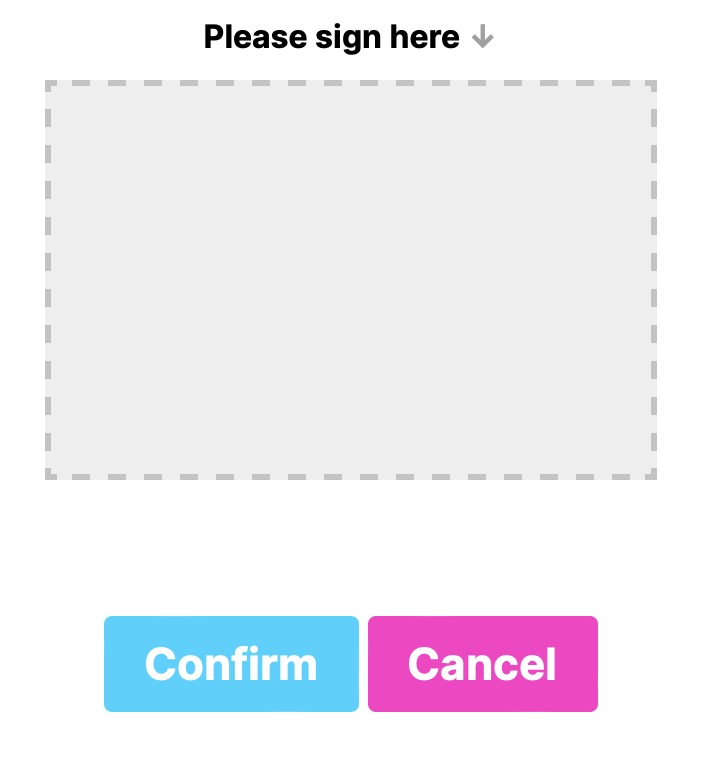
As stated above, these documents can be signed. If you share the URL of the document with the user they are redirected to a page where the document is displayed with a signing zone at the bottom.

<figure><img src="https://55689121-files.gitbook.io/~/files/v0/b/gitbook-x-prod.appspot.com/o/spaces%2FMH0qx2kDusOMcs9TvihF%2Fuploads%2Fgit-blob-ebcf7cae48d5b98c1d1afb2c9e0a5883af07b952%2FScreenshot%202023-09-01%20at%2021.56.16.jpg?alt=media" alt="" width="354"><figcaption><p>An example of the signing zone of a document.</p></figcaption></figure>

If on a touch screen (phone, tablet) the user can sign using their finger. On a normal computer they can use their mouse.

{% hint style="info" %}
Documents can be [signed](/event/accreditation/check-in-out/document-signing.md) digitally on our platform.

But sometimes you have a less tech-savvy person who prints out the document, signs it manually, takes a picture and sends it back to you. This way you can upload that picture and the document will be marked as signed.
{% endhint %}

## How to's

* [Preview document signing process](https://docs.eventication.com/event-how-to/general/documents/preview-document-signing-process)


---

# Agent Instructions
This documentation is published with GitBook. GitBook is the documentation platform designed so that both humans and AI agents can read, navigate, and reason over technical content effectively. Learn more at gitbook.com.

## Querying This Documentation
If you need additional information that is not directly available in this page, you can query the documentation by asking a question.

Perform an HTTP GET request on the following URL with the `ask` and `goal` query parameters:

```
GET https://docs.eventication.com/event/general/documents.md?ask=<question>&goal=<user_goal>
```

`ask` is the immediate question: it should be specific, self-contained, and written in natural language.
`goal` is what the user is ultimately trying to achieve, the reason they need the answer. Sharing it helps GitBook give you a better, more relevant answer. A goal is most helpful when it describes the outcome the user wants rather than restating the question. For example, with `ask=how do I create an API token`, a goal like `automate deployments from our CI pipeline` lets GitBook tailor the answer to that use case.

The response will contain a direct answer to the question and relevant excerpts and sources from the documentation.

Use this mechanism when the answer is not explicitly present in the current page, you need clarification or additional context, or you want to retrieve related documentation sections.
